Are you interested in a rewarding career that allows you to make significant, meaningful contributions to society? As an English Education concentrator, you will be eligible for an endorsement from the State of Colorado in teaching English in grades 6–12.
This concentration focuses on learning how to grow and develop middle and high school readers, writers, thinkers, speakers, and listeners, using equity-driven and critically conscious research to prepare young people to become critically thinking global citizens.
What You’ll Study
Our program is based in local schools, offering you authentic opportunities to engage with 6th-12th grade students to learn responsive teaching practices and discover how teaching is a work of the heart. Using socially, culturally, and linguistically diverse approaches, our courses emphasize the transformative power of literacy as a tool for liberation, promote equity and access, and enact social change.
Student Teaching
Co-teaching puts you in the classroom, alongside a master teacher, early in our program. During practicums, you’ll lead small groups of students, collaborate with the classroom teacher on lesson plans, learn to lesson plan by yourself, and even teach a class while the cooperating teacher supervises. In your final year of the program, you’ll complete your secondary student teaching in a local classroom within Fort Collins and Loveland, or Northern Colorado.
This course explores the ways in which literary critical theories and approaches can be used to frame texts and rethink pedagogy for secondary education. Students will apply lenses for understanding young adult texts and centering equity in education.
This course is designed to give future teachers, writers, and literature students a survey of mostly contemporary novels for young adults. During this course we’ll read and discuss approximately a book a week, with a focus on applying a critical literacy lens to explore texts that engage adolescents.
This course is designed to prepare middle and high school teachers to teach reading, writing, speaking, and listening in English/Language Arts classrooms. Our work will be centered in anti-racist and anti-oppressive pedagogies and will focus on the processes, principles, and practices of supporting learners. Upon completion of this course, students will be better able to ground their instruction in the standards, plan lessons and units, consider means for assessing learning, implement sound practices in their classrooms, and enter into professional conversations about the teaching of English. The course is designed in an experiential way in order for pre-service teachers to learn and practice skills and strategies to better understand their validity and usefulness in the classroom.
English Education Roadmap: Courses & Requirements
English majors must complete a minimum of 120 credits, 42 upper-division credits to graduate. For licensure, students must complete all coursework in the teaching concentration and professional education with a grade of C or above, and must have a cumulative GPA of 2.750.
Below, learn more about the requirements for the English Education concentration.
CO 150 College Composition
E 150 English Studies Symposium
One Cross-Concentration class—choose from the following options:
E 202 Language Use in Society
E 204 Creative Writing as Transformative Practice
E 206 Language for Activist Rhetoric & Writing
E 237 Introduction to Science Fiction
One Introductory Literature class—choose from the following options:
E 236 Short Fiction
E 238 Contemporary Global Fiction
E 240 Intro to Poetry
E 242 Reading Shakespeare
E 245 World Drama
E 270 Intro to American Lit
E 276 British Literature – Medieval to 1800
E 277 British Literature – After 1800
One Methods class—choose from the following options:
E 301 Framing Texts & Critical Theory in Equity (highly recommended)
E 305 Principles of Writing & Rhetoric
E 320 Intro to the Study of Language
E 341 Literary Criticism and Theory
E 200 Inquiry-Based Teaching and Communicating
E 322 English Language for Teachers
E 401 Teaching Reading
E 402 Teaching Composition
E 405 Young Adult Literature
Capstone Course: E 465 Topics in Language & Literature OR E 466 Integrated English Studies
Note: English Education concentrators should fulfill the subsequent AUCC requirements as follows:
Additional Communication: CO 301 D Writing in the Disciplines: Education
Social/Behavioral Sciences: EDUC 275 Schools, Society, and Self
Global & Cultural Awareness—choose one from the following options:
E 142 Reading Without Borders
E 245 World Drama
LB 173 Encountering the Global
Earn remaining credits from your choice of history, social science, arts & humanities, environmental studies & sustainability, and more!
Career & Professional Pathways
Students in the English Education concentration most often go on to become middle and/or high school English Language Arts teachers, and each CSU graduate earns their Colorado teaching license (which can be transferred to other states). Our alumni have also been admitted to M.A. and Ph.D. programs specializing in equity, social justice, and higher education leadership.
Additional career options include:
Department Chair or Administrator
Curriculum Designer
School Librarian
School and Library Marketing Specialist for YA and Children’s Literature
Organizational Education Consultant
Human Resources Manager
Hands-on Learning
As a pre-service educator, you’ll build your skills and confidence through experiences that connect theory to real classroom practice. Get involved with the CSU Center for Educator Preparation, explore professional development opportunities through the National Council of Teachers of English (NCTE), or earn internship credit as a teaching assistant.
Center for Educator Preparation: Part of the CSU School of Education, the Center for Educator Preparation equips future teachers and principals seeking careers as licensed educators.
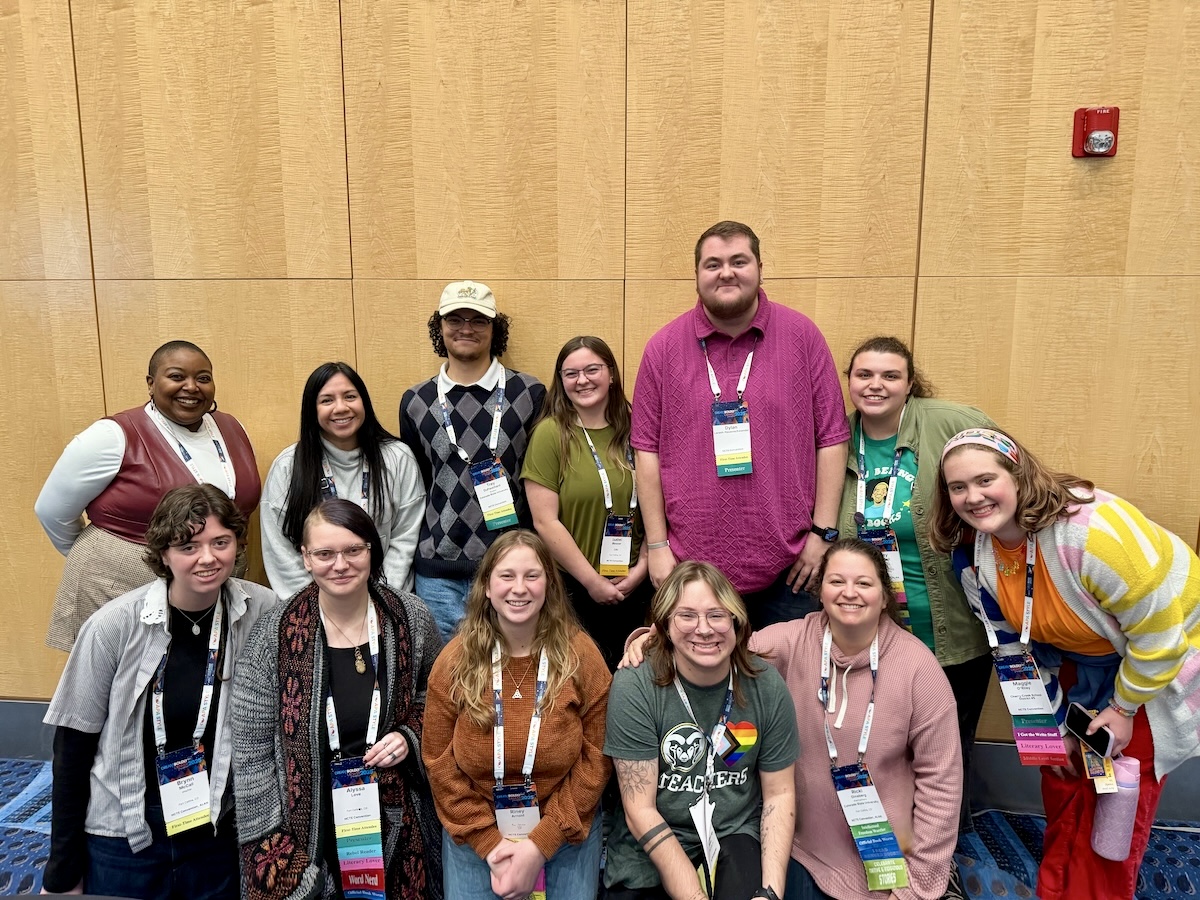
NCTE: Every year, the CSU English Education community presents research, facilitates discussions, and shares professional experiences at the National Council of Teachers of English (NCTE) Convention. Undergraduates have gained hands-on experience presenting on mental health literacy and leading roundtable discussions with young adult authors.
Become a Teaching Assistant: Gain impactful teaching experience as a teaching assistant for an English faculty member. Student TAs get a first-hand preview into the ins and outs of research, grading best practices, and lesson planning with guidance from a trusted, supportive mentor.
Faculty Profiles
Learn from supportive, award-winning teacher-educators who are invested in helping you grow your teaching practice and philosophy.
“I appreciate the English Education program’s focus on creating equitable and inclusive settings within the content and classrooms of our courses. I am confident in my ability to conduct my future classrooms with compassion and grace and have the resources to educate and inspire the world’s future leaders holistically.”
— Marquita Woods, B.A. ’23
“What I love most about being an English major at CSU is how tight-knit our department is. There’s such a strong sense of community in every classroom I step into. With the support of my amazing peers and professors, I’ve learned how to use my voice and have grown more confident in my creativity.”