Creative Writing
Fiction, Poetry, and Creative Nonfiction
The Creative Writing concentration gives students the opportunity to write compelling short stories, poems, and personal essays, while developing a firm knowledge of literary techniques, forms, and genre-specific conventions in fiction, poetry, and creative nonfiction.
Creative Writing Concentration
Be Creative
As an English major concentrating in creative writing, you’ll have the opportunity to take beginning, intermediate, and advanced courses centered on developing your individual voice while infusing your writing and reading skills with imagination.
Through writing workshops and literature courses, you’ll sharpen your ability to closely read, analyze, and discuss both published and peer-produced work—paying close attention to form, structure, voice, and word choice.
Additionally, you’ll build practical skills in analyzing and revising written creative expression, thinking critically about how subtle changes can make a big difference in how writing is understood and received. You’ll also explore how creative writing connects with fields like communications, history, education, healthcare, environmental and natural resources, psychology, and more.
Creative Writing Roadmap: Courses & Requirements
English majors must complete a minimum of 120 credits, 42 upper-division credits to graduate. Below, learn more about the requirements for the Creative Writing concentration.
- CO 150 College Composition
- E 150 English Studies Symposium
- SPCM 200 Public Speaking
- Two Cross-Concentration classes—choose from the following options:
- E 200 Inquiry-Based Teaching and Communicating
- E 202 Language Use in Society
- E 204 Creative Writing as Transformative Practice (recommended)
- E 206 Language for Activist Rhetoric & Writing
- E 237 Introduction to Science Fiction
- One Introductory Literature class—choose from the following options:
- E 236 Short Fiction
- E 238 Contemporary Global Fiction
- E 240 Intro to Poetry
- E 242 Reading Shakespeare
- E 245 World Drama
- E 270 Intro to American Lit
- E 276 British Literature – Medieval to 1800
- E 277 British Literature – After 1800
- One Methods class—choose from the following options:
- E 301 Framing Texts & Critical Theory in Equity
- E 305 Principles of Writing & Rhetoric
- E 310 Researching and Writing Literary Criticism
- E 320 Intro to the Study of Language
- E 341 Literary Criticism and Theory (recommended)
- E 210 Beginning Creative Writing
- Choose one from the following intermediate courses:
- E 311A Intermediate Creative Writing: Fiction
- E 311B Intermediate Creative Writing: Poetry
- E 311C Intermediate Creative Writing: Nonfiction
- Choose one from the following advanced workshops (must match genre of intermediate course taken):
- E 412A Creative Writing Workshop: Fiction
- E 412B Creative Writing Workshop: Poetry
- E 412C Creative Writing Workshop: Nonfiction
- Capstone Course: E 465 Topics in Language & Literature OR E 466 Integrated English Studies
Earn 18 credits from your choice of upper-division English/Composition electives in consultation with your academic success coordinator.
Must include one Composition course from the following options:
- CO 300 Writing Arguments
- CO 301A Writing in the Disciplines: Arts and Humanities
- CO 301B Writing in the Disciplines: Sciences
- CO 301C Writing in the Disciplines: Social Sciences
- CO 301D Writing in the Disciplines: Education
- CO 302 Writing in Digital Environments
Earn 31 credits from your choice of foundational courses offered across the university. A cumulative grade point average of 2.0 is required in all AUCC courses.
Earn remaining credits from your choice of history, social science, arts & humanities, environmental studies & sustainability, and more!
Creative Writing concentrators can meet the second field requirement by either completing the second year of a foreign language, or by completing 12 upper-level credits in a cohesive field of study outside of English.
Path to My Major
Erin Fuller (they/he) is an English major concentrating in Creative Writing with a minor in Music, Stage, and Sports Production.

-
Why did you choose to study English?
English is one of the few things that I’ve been passionate about my entire life. I knew I had to study something that makes me happy and will fuel my passion, so I knew English was the path for me.
-
Favorite class and why?
My favorite class so far is intermediate creative writing: nonfiction, or E311C. I really enjoyed honing into my love for creative nonfiction and I wrote a piece I’m very proud of in that class.
-
Career path you’re interested in pursuing?
My main goal after college is to become a professional playwright, as I’ve been writing plays since high school and been acting since way before that. Right out of college, though, I’ll probably work in radio or music of some sort, as I work at the campus radio station and have gained a passion for production and editing.
Explore & Engage

Course Highlights
- E 150: English Studies Symposium
- E 210: Beginning Creative Writing
- E 240: Introduction to Poetry
- E 311: Intermediate Workshop
- E 412: Creative Writing Workshop
Get Involved
Interested in literary publishing?
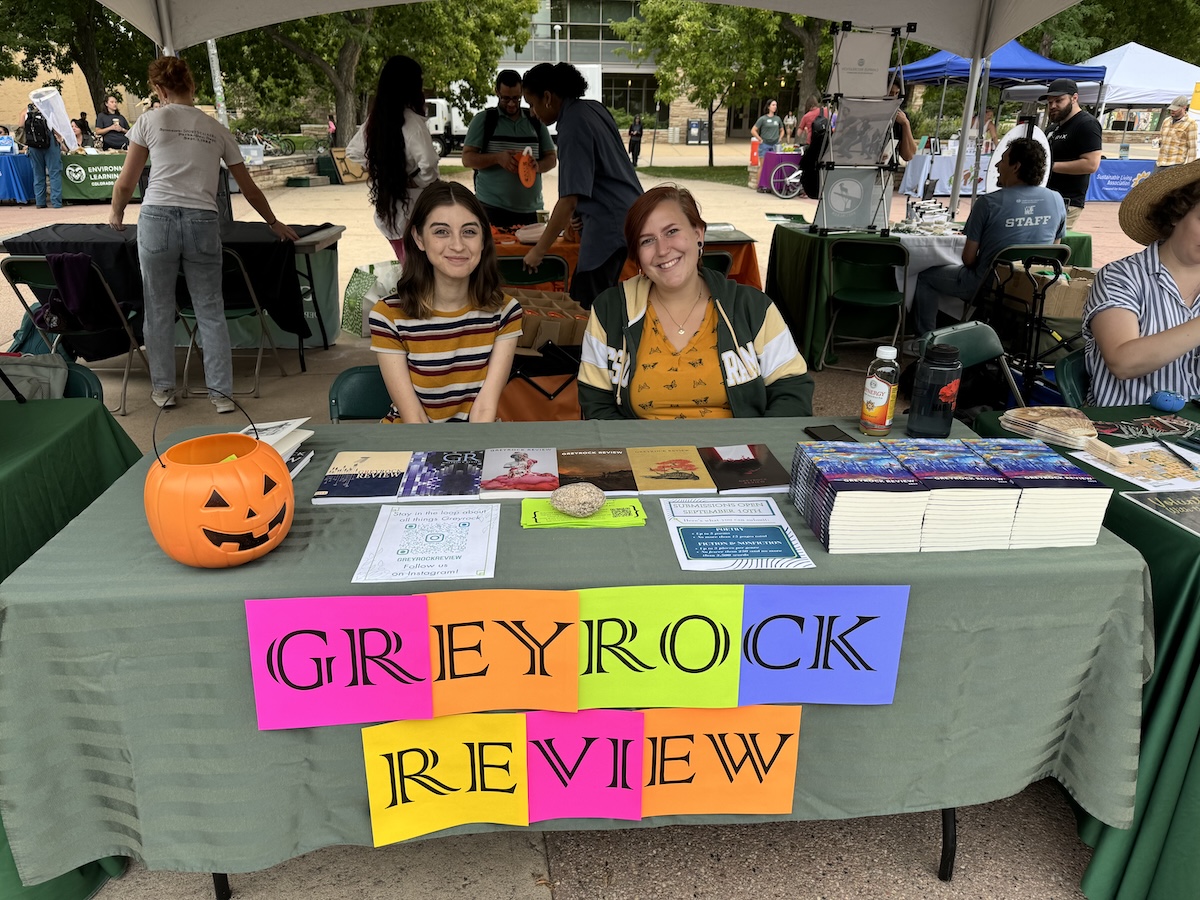
Apply for an internship at our undergraduate literary magazine Greyrock Review.
Want to share poetry with your peers? Join our student-run poetry club: Dead Poets Society.
Make friends and create community! Connect with English majors through Inklings, our student-run English social club.
Career Paths
What can I do with this major?
Students who have chosen to major in English with a concentration in Creative Writing have pursued careers in publishing and editing, communications, marketing & public relations, education, healthcare, and more.
Alumni have also built active writing careers, landing book deals in fiction, nonfiction, and poetry.
What Are Students Saying?
“I felt comfortable connecting with professors on a personal level which allowed me to feel comfortable when stretching my creative boundaries – because I did not fear being criticized or discouraged by professors. Their overall focus wasn’t to teach us one way of learning or one school of thought but to expand our horizons and allow us to discover the terrain on our own.”
~ Teal Vickrey, BA English: Creative Writing


“When I took my first creative writing class in the department, I knew it was my home. My favorite part of the English program was my professors. They were an amazing group of people and I wouldn’t be the same without their support, encouragement and critique.”
~Whitney Pratz, BA English with concentration in Creative Writing and an MFA: Creative Writing
“I initially started out as a Business Major, but it was only in my English classes that I felt completely and wholly stimulated by everything I was engaged with. I think you have to devote yourself to that feeling when you are lucky enough to find it.”
~Justin Goodfellow, BA English: Creative Writing